About this app
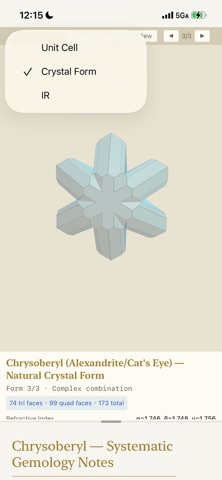
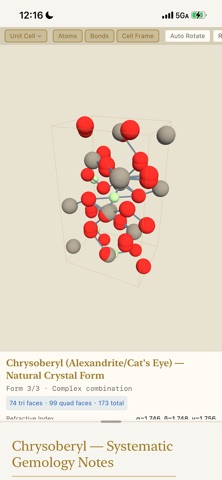
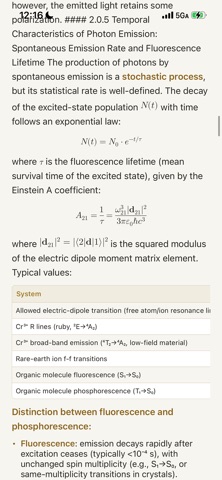
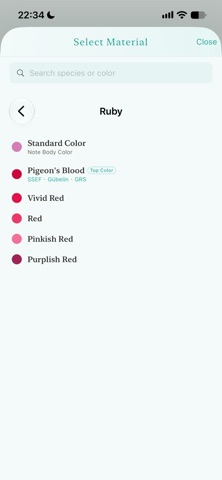
Systematic Gemology Notes An offline reference app dedicated to gemology learning, covering the fundamental properties, crystal structures, and systematic classification of common gemstones. KEY FEATURES • Gemstone Browser — Reference material organized by crystal system and gemstone species • 3D Crystal Models — Interactive displays of each gemstone's crystal structure; rotate and zoom to examine every angle • Detailed Notes — Systematic knowledge covering physical properties, optical characteristics, and key identification points • Fully Offline — No internet connection required; study anywhere, anytime Ideal for gemology students, professional gemologists and appraisers, jewelers, and collectors.
Latest release
What’s New
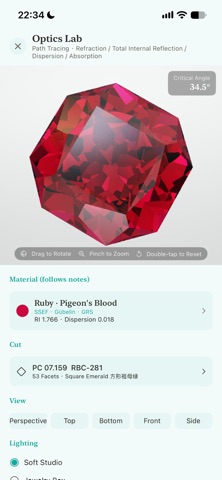
What's New in 2.3.2 • New "Polariscope Lab": a polariscope simulation alongside the Optics Lab, built on physically based polarized-light ray tracing — showing birefringence, extinction and interference as plane-polarized light passes through a gemstone, in real time. • Three independent polarizers: rotate the lower polar (polarizer) and the upper polar (analyzer) independently from 0–180°, and insert a third mid polarizer. Placing a 45° mid polar between crossed polars turns the dark field bright — the classic three-polarizer experiment, fully reproduced. • Conoscopic interference figures: two viewing modes, ideal (analytic) and true ray-traced. Observe the uniaxial black cross with concentric isochromes, the bull's-eye figure of quartz, and the biaxial hyperbolic brushes with both optic-axis emergence points, using constants measured from the system notes. • Rotating stage and optic-axis orientation: rotate the stage a full 360° to watch the figure evolve; tilt the optic axis off the stage normal to simulate searching for the interference figure under the microscope. For biaxial stones, orientation is described by the optic bisectrix (the acute bisectrix, Bxa). • Free inspection: white D65 daylight for interference colors and pleochroism, or the sodium D line for clean isochromes; set crossed, parallel or any angle, with a Malus's-law transmission readout. • Note: the simulation is for teaching and comparative observation; it does not constitute a gemological identification.
Audience growth
Ratings growth
Baseline captured. Growth appears after the crawler observes a changed rating count.
Momentum comes from crawler snapshots for the tracked storefront. “Viral growth signal” means unusually fast recent rating gains; it is an indicator, not download data.
Price tracking
Price intelligence
- First observed Aug 20, 2026 · 2:24 PM Free
Screenshots